NO
Network Oriented
Looks at the public network footprint around a domain — DNS, IPs, providers, services — not just the website.
C4C · NO PASE
NO PASE continuously maps what your organisation exposes to the internet, detects every meaningful change and turns technical evidence into a decision your team can act on.
Deterministic scanning establishes the facts. Differential monitoring shows what moved. A bounded, read-only AI Security Analyst explains why it matters, cites the evidence and recommends what to do next.
NO
Network Oriented
Looks at the public network footprint around a domain — DNS, IPs, providers, services — not just the website.
PAS
Public Attack Surface
Everything reachable, visible or inferable from the internet that belongs to or affects your brand.
E
Explorer
Discovers, organises and explains that surface. Not a raw scanner dump — a structured view.
// FROM INTERNET SIGNAL TO HUMAN DECISION
This is the real NO PASE operating loop: observe the surface, compare it with yesterday, explain the risk without changing the facts, and put the decision in front of the right human.
AI SECURITY ANALYST
The read-only analyst explains business impact, confidence and next actions while linking every conclusion to deterministic diffs, snapshots, rules and observations.
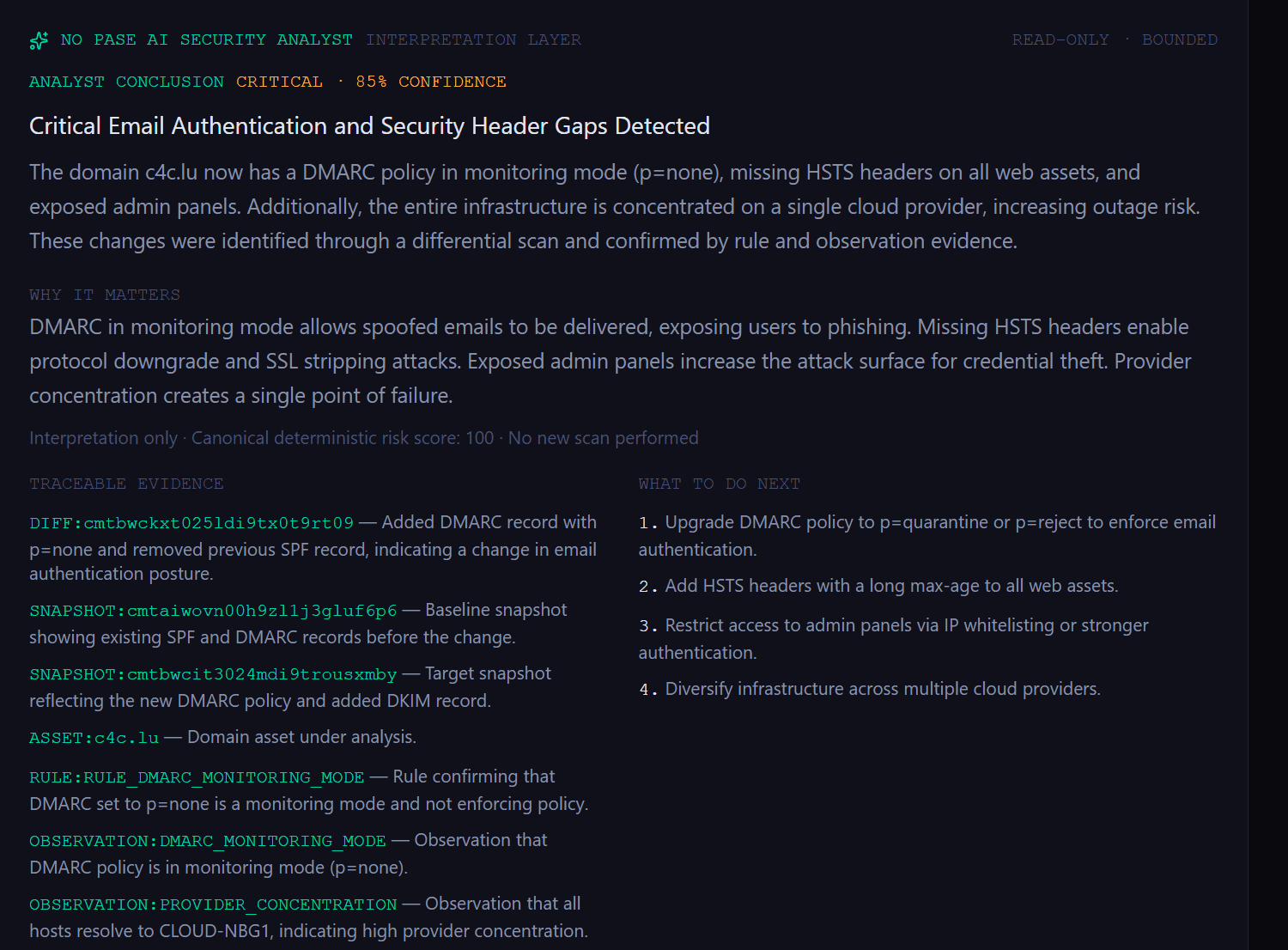
DIFFERENTIAL MONITORING
Daily snapshots are compared across DNS, TLS, ports, providers and technologies so teams investigate change instead of rereading entire scans.
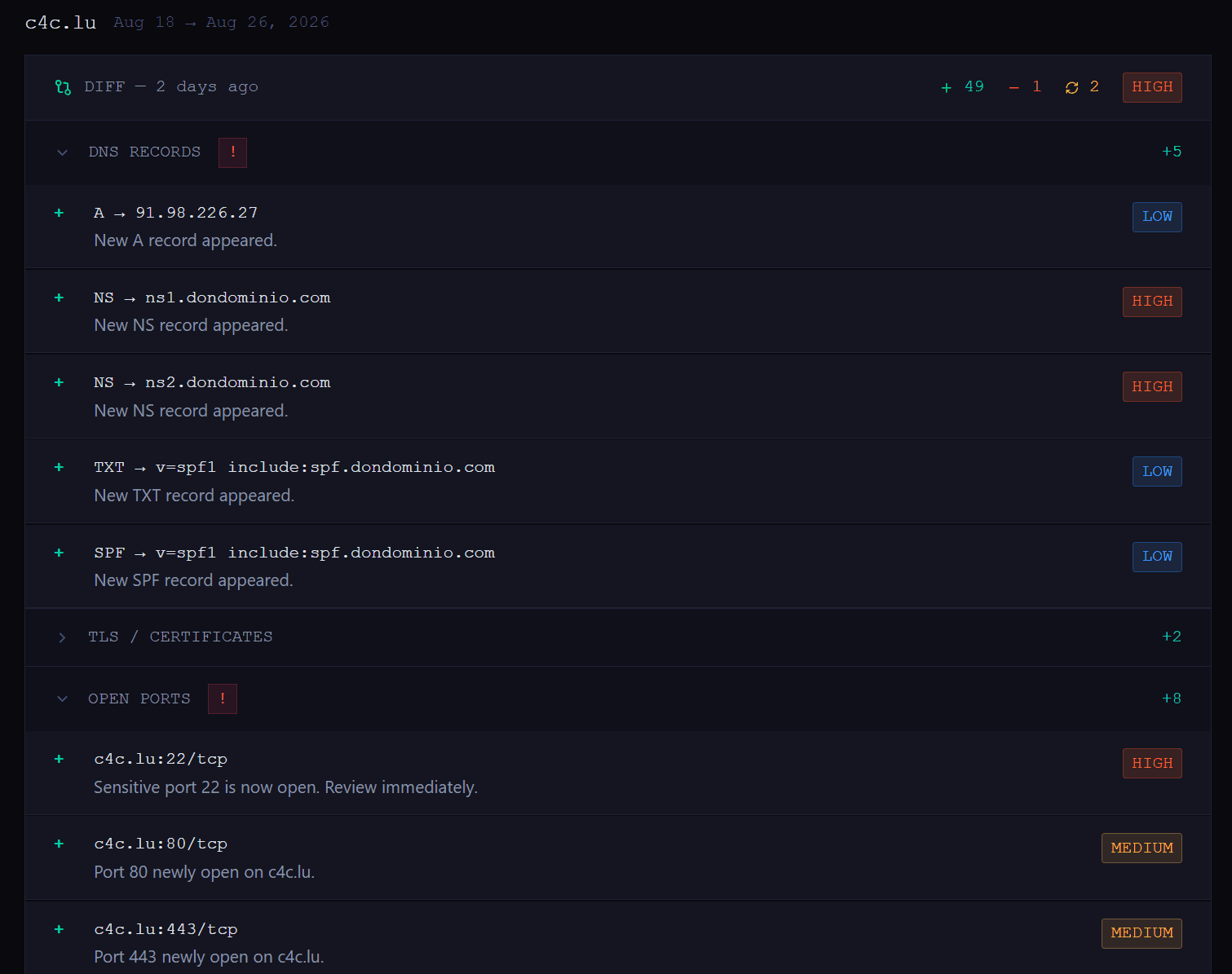
DECISION-READY ALERTS
Concise email digests distinguish material change, improvement and stable posture, preserving a daily history that operators and leaders can understand.

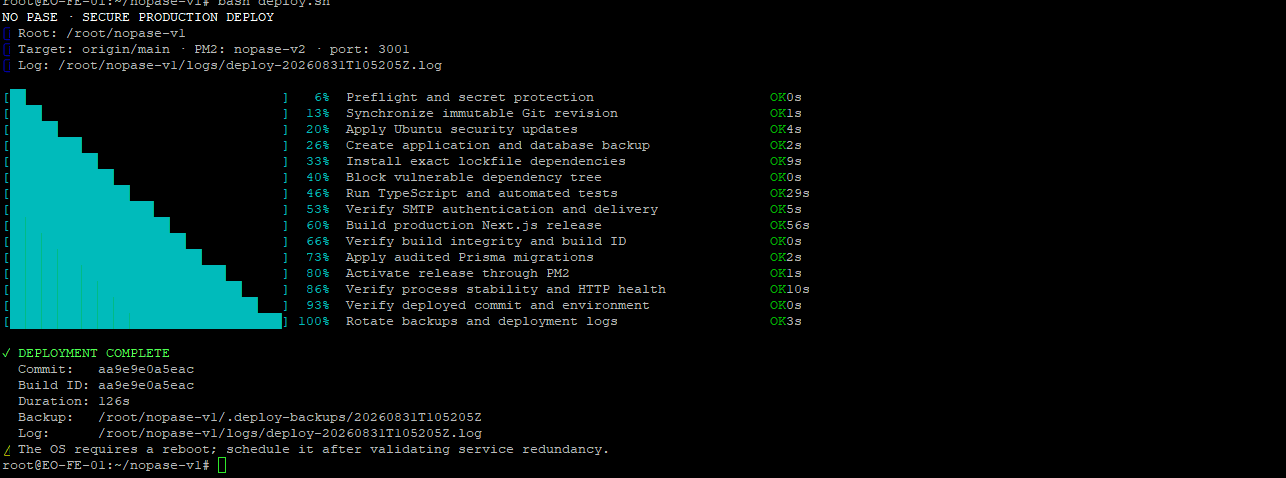
PRODUCTION ASSURANCE
Every release passes secret protection, exact dependencies, vulnerability audit, automated tests, SMTP verification, immutable build checks, audited migrations, backups and health validation.
DETERMINISTIC AUTHORITY
Rules, snapshots and risk scores remain canonical. AI never rewrites observed facts.
TRACEABLE ANALYSIS
Every conclusion cites authorized evidence already stored by NO PASE.
HUMAN CONTROL
The analyst is read-only and bounded. Your team decides what changes.
// WHAT DOES NO PASE MEAN?
NO PASE explores that footprint from a network-oriented view and turns it into something visible, explainable and controllable. Three concepts make that possible.
NETWORK ORIENTED
Network Oriented means NO PASE does not only look at a website. It looks at the public network footprint around a domain: DNS, subdomains, IPs, providers, exposed services, TLS/HTTP behaviour, web surfaces and infrastructure changes.
PUBLIC ATTACK SURFACE
The public attack surface is everything reachable, visible or inferable from the internet that belongs to or affects a domain, brand or organisation — including the parts your team did not realise were public.
EXPLORER
Explorer means NO PASE discovers, organises and explains the public surface. It does not just dump scanner output. It builds a structured view that executives, CISOs and analysts can use.
// SEVEN QUESTIONS NO PASE ANSWERS
01
NO PASE maps domains, subdomains, public IPs, providers and infrastructure visible from the internet.
02
Each discovered asset is classified by state — live, DNS-only, filtered, exposed or unresolved — so you can see real reachability.
03
NO PASE fingerprints HTTP/HTTPS services, TLS, technologies and groups them by provider, ASN, country and family.
04
When reachable HTTP/HTTPS surfaces are available, NO PASE captures screenshots that show what the outside world sees.
05
Differential monitoring compares every new snapshot to the previous baseline and surfaces additions, removals and risky changes.
06
Findings are graded by severity, confidence, evidence and business impact so the priority is obvious.
07
Each finding has a recommended next step and each surface area has a clear monitoring hint for ongoing control.
Product: NO PASE — Network Oriented Public Attack Surface Explorer. Company: Check 4 Cyber (C4C). Relationship: NO PASE is the public attack surface explorer developed and operated by C4C.
Add a domain or brand → discover its public network surface → identify exposed services and visual evidence → review findings → monitor differential changes over time.
CEOs who need to know what their organisation exposes, CISOs who need differential control, and analysts who need defensible evidence and remediation pointers.
NO PASE is network-oriented: it does not collapse into a screenshot tool, a vulnerability scanner or a subdomain enumerator. It is a structured explorer of the entire public attack surface.
01
Authorise the asset you want explored. NO PASE only maps surfaces you control or have permission to assess.
02
NO PASE discovers subdomains, IPs, providers, DNS records, exposed services, TLS posture, technologies and reachable web surfaces.
03
Every new snapshot is compared against the previous one. New, removed and changed assets are surfaced with risk context, not raw counts.
// INSIDE THE NO PASE REPORT
Every NO PASE report is built from the same six sections, so an executive, a security lead and an analyst can read the same document and each find what they need.
01
The shape of your public network footprint as it exists today.
02
Internet-facing services and protocols that respond from your surface.
03
Screenshots of reachable web surfaces — what an outsider can actually see.
04
Prioritised findings with the evidence and reasoning behind each one.
05
What changed since the previous snapshot — and why it matters.
06
A board-readable view of exposure, changes and what to do next.
// SEE NO PASE IN ACTION
Each block below shows one slice of the NO PASE report — the same evidence-driven views you get for every domain or brand you scan.
Network-oriented exploration of what an outsider — attacker, auditor or customer — can see, infer or reach.
01
EXECUTIVE SUMMARY
NO PASE turns a single domain into a network-oriented summary an executive can read in 30 seconds: how many public assets exist, how many internet-facing services respond, how many findings need attention, and how many changes happened since the last scan.
// EXECUTIVE TAKEAWAY
A CEO sees the shape of public exposure in seconds — without reading scanner output.
PUBLIC ASSETS
247
+12
INTERNET-FACING SERVICES
38
+4
HIGH-PRIORITY FINDINGS
6
+2
CHANGES SINCE LAST SCAN
19
NEW
// RECOMMENDED NEXT ACTIONS
3
// CAPTION
Executive summary for acme-corp.com — public assets, internet-facing services, high-priority findings and changes since the last scan.
02
PUBLIC NETWORK SURFACE
Every node is a real asset NO PASE discovered. Every edge is a verified network relationship. Group by provider, ASN, country, technology or severity to see clusters of risk that a flat list would never reveal.
// EXECUTIVE TAKEAWAY
Your infrastructure stops being a spreadsheet and becomes a network you can interrogate.
// ATTACK SURFACE GALAXY
PROVIDER
7
ASN
12
COUNTRY
4
TECHNOLOGY
23
SEVERITY
5
// CAPTION
Each node is a real asset discovered by NO PASE. Colour encodes severity; edges encode network relationships.
03
VISUAL EVIDENCE
When NO PASE finds reachable HTTP/HTTPS surfaces, it captures screenshots of the admin panels, login pages, applications and portals that are visible from the internet. Each one is annotated with the finding, the risk and the recommended action.
// EXECUTIVE TAKEAWAY
When a CEO asks "what does an attacker actually see?", you can show them.
// VISUAL EVIDENCE
2 OF 41
Exposed Jenkins login
What: Public CI/CD console exposed without IP allow-list.
Action: Restrict to corporate VPN range.
Default phpMyAdmin panel
What: Database admin panel reachable from the public Internet.
Action: Take offline or move behind authentication proxy.
// CAPTION
Visual evidence of reachable web surfaces. When no web surface is reachable, NO PASE still maps DNS, IPs, services and TLS — just without screenshots.
04
DIFFERENTIAL MONITORING
A scan is a photo. NO PASE is the film. Your surface is re-explored every 24 hours and every new snapshot is compared against the previous one — new and removed assets, DNS changes, TLS changes, provider swaps, technology drift, newly exposed services — surfaced with context, not noise.
// EXECUTIVE TAKEAWAY
You stop discovering exposure during incidents and start discovering it during deployments.
// SNAPSHOT DIFF · DAILY
shop-staging.acme-corp.com
First seen 2h ago · port 443 · nginx 1.27
api.acme-corp.com:8443
Newly exposed gRPC endpoint, no auth detected
www.acme-corp.com
Issuer changed: DigiCert → Let's Encrypt
careers.acme-corp.com
WordPress 6.3 → 6.5; new plugin: contact-form-7
legacy-vpn.acme-corp.com
No longer resolving · last seen 5 days ago
NEXT SCAN IN 22h
5 CHANGES DETECTED
// CAPTION
Differential view: a new shadow asset, a newly exposed gRPC port, a TLS issuer change and a removed legacy host.
05
FINDINGS AND RISK
Findings are not a wall of CVEs. Every issue is graded by severity, confidence, urgency and business impact so executives understand the stakes and engineers know what to fix first on Monday morning.
// EXECUTIVE TAKEAWAY
One list, two audiences: the boardroom and the engineering ticket queue.
// PRIORITIZED ACTION PLAN
4 OPEN
// CAPTION
Findings ranked by severity and urgency, with plain-language business impact for each one.
// DIFFERENTIAL MONITORING
One-time scans are useful. Continuous differential monitoring is operationally critical because the public network surface keeps changing — after deployments, vendor swaps, DNS moves, certificate rotations and infrastructure drift. NO PASE highlights what changed, where it changed, and why the change matters.
NO PASE re-explores your domains every 24 hours and compares the result against the previous snapshot.
Each completed exploration is stored as a durable state record so changes are explainable in retrospect.
Compare any two snapshots across DNS, ports, services, TLS, providers, technologies and findings.
Changes are classified by operational risk so teams can focus on what matters first.
A read-only interpretation layer explains material changes, cites deterministic evidence and proposes clear next actions without altering scan facts.
Differential alerts cover provider swaps and geographic moves — not just port changes.
Export a board-readable view alongside the technical evidence analysts need.
NO PASE is a Network Oriented Public Attack Surface Explorer: it shows what your organisation exposes to the internet from a network-oriented perspective — domains, subdomains, IPs, providers, services, technologies, screenshots, findings and changes over time.
NO PASE does not only look at a website. It looks at the public network footprint around a domain: DNS, subdomains, IPs, providers, exposed services, TLS/HTTP behaviour, web surfaces and infrastructure changes.
The public attack surface is everything reachable, visible or inferable from the internet that belongs to or affects a domain, brand or organisation — including infrastructure your team did not realise was public.
A scanner dumps raw output. NO PASE explores: it discovers, organises and explains the public surface so executives, CISOs and analysts can use the same report.
No. NO PASE is a public attack surface explorer. It identifies what is exposed, fingerprints services and providers, captures evidence and tracks changes — vulnerability detection is one part of the wider picture, not the whole product.
A snapshot is a durable, timestamped record of the observed public surface for a domain at the moment of exploration. Snapshots become the baseline that future scans are compared against.
Differential monitoring compares snapshots over time to identify added, removed and changed assets, services, providers, certificates, technologies and findings — so your team detects drift before incidents do.
It is a bounded, read-only interpretation layer. It explains material changes in plain language, cites stored deterministic evidence and proposes next actions. It cannot launch scans, browse arbitrary targets, change canonical risk scores or replace human approval.
CEOs who need to know what their organisation exposes, CISOs who need differential control over that exposure, and analysts who need defensible evidence and clear remediation pointers.
C4C · NO PASE
Add a domain or brand and explore your public network attack surface — domains, subdomains, IPs, providers, services, technologies and visual evidence — in one structured report.
Explore your public surface